



09
2025
-
03
Demolding technology in china prototype aluminum casting
Author:
In the process of prototype aluminum casting, demolding technology is a key link, which directly affects the quality and production efficiency of the final product.
Demolding technology is first closely related to the design of the mold. Reasonable mold structure can facilitate demolding. For example, the appropriate demolding slope is adopted to make it easier for aluminum castings to be separated from the mold cavity after cooling and shrinking. Generally speaking, the size of the slope is determined according to factors such as the shape, size and height of the casting, usually between 0.5° - 3°. At the same time, the design of the parting surface of the mold should also consider the convenience of demolding, try to avoid complex parting structures, and reduce the adhesion points between aluminum castings and molds.
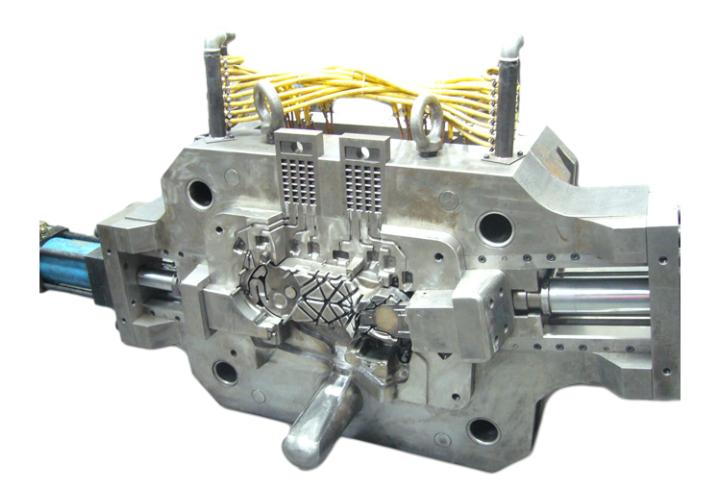
In terms of the application of demolding agents, this is an important part of demolding technology. The demolding agent forms an isolation film between the aluminum liquid and the mold to reduce the friction between the aluminum casting and the mold. High-quality demolding agents need to have good high temperature resistance, chemical stability and lubricity. In prototype aluminum casting, it is crucial to choose a suitable demolding agent according to different process requirements and mold materials. For example, for some high-precision prototype castings, it may be necessary to use a specially formulated demoulding agent to ensure that the surface quality of the casting is not affected during the demoulding process.
Mechanical demoulding devices have also been widely used in modern prototype aluminum casting. Through ejection mechanisms, such as ejector rods and ejector plates, a certain force is applied at the right time to eject the aluminum casting from the mold. The action of these ejection mechanisms needs to be precisely controlled. Too little force may cause the casting to fail to be demoulded smoothly, while too much force may cause deformation or damage to the casting. In addition, for some aluminum castings with complex shapes, it may be necessary to use a combined demoulding device, such as a side core pulling mechanism combined with an ejection mechanism, to achieve a complete and lossless demoulding process. In short, the continuous optimization of demoulding technology is an important guarantee for improving the quality and efficiency of prototype aluminum casting.
prototype aluminum casting
30
2026-09
The Art of Crafting Durable Aluminum Casts for Industrial Applications
27
2026-09
The Essential Guide to Die Casting: Techniques, Applications, and Benefits
24
2026-09
How to Stay Ahead in Mold Forging: Insights for Manufacturers
21
2026-09
The Essential Guide to Forging Molds: Understanding Their Importance in Manufacturing
18
2026-09
Zinc Die Casting Parts: A Premier Cost-Effective Solution for Customized Manufacturing
15
2026-09
The Intricacies of Zinc Alloy Die Casting: A Comprehensive Overview
12
2026-09
The Art of Creating Intricate Designs Through Aluminum Prototype Casting
GM Diecasting Technology Co.,Limited.
Add:Building 1-5, Chongke Road, Shipai Town, Dongguan City, Guangdong Province
Email:henry@gmdiecastingtech.com
Email:lily@gmdiecastingtech.com
Tel:+8613680864695